Beyond the Grid: Elevating Miami’s Skyline Through Perspective and Technical Precision
![[HERO] Beyond the Grid: Elevating Miami’s Skyline Through Perspective and Technical Precision](https://images.squarespace-cdn.com/content/v1/65709c5d3811307fc2c8dc79/f4fb0441-1359-4660-a2b9-407a8b759dde/GrUqx8O8H05.webp)
The Miami skyline is no longer a collection of disparate silhouettes; it has evolved into a sophisticated dialogue between visionary urban planning and high-stakes engineering. As the city transitions from traditional gridded developments to interconnected vertical communities, the demand for editorial architectural photography has shifted from simple documentation to a nuanced art form. This article will explore the technical rigors of high-rise photography in South Florida, the strategic shift toward district-wide visual narratives, the impact of geometric precision on brand perception, and how professional imagery serves as a critical asset for developers and design firms aiming to secure market leadership in a competitive landscape.
Why Does Technical Precision Dictate Brand Perception?
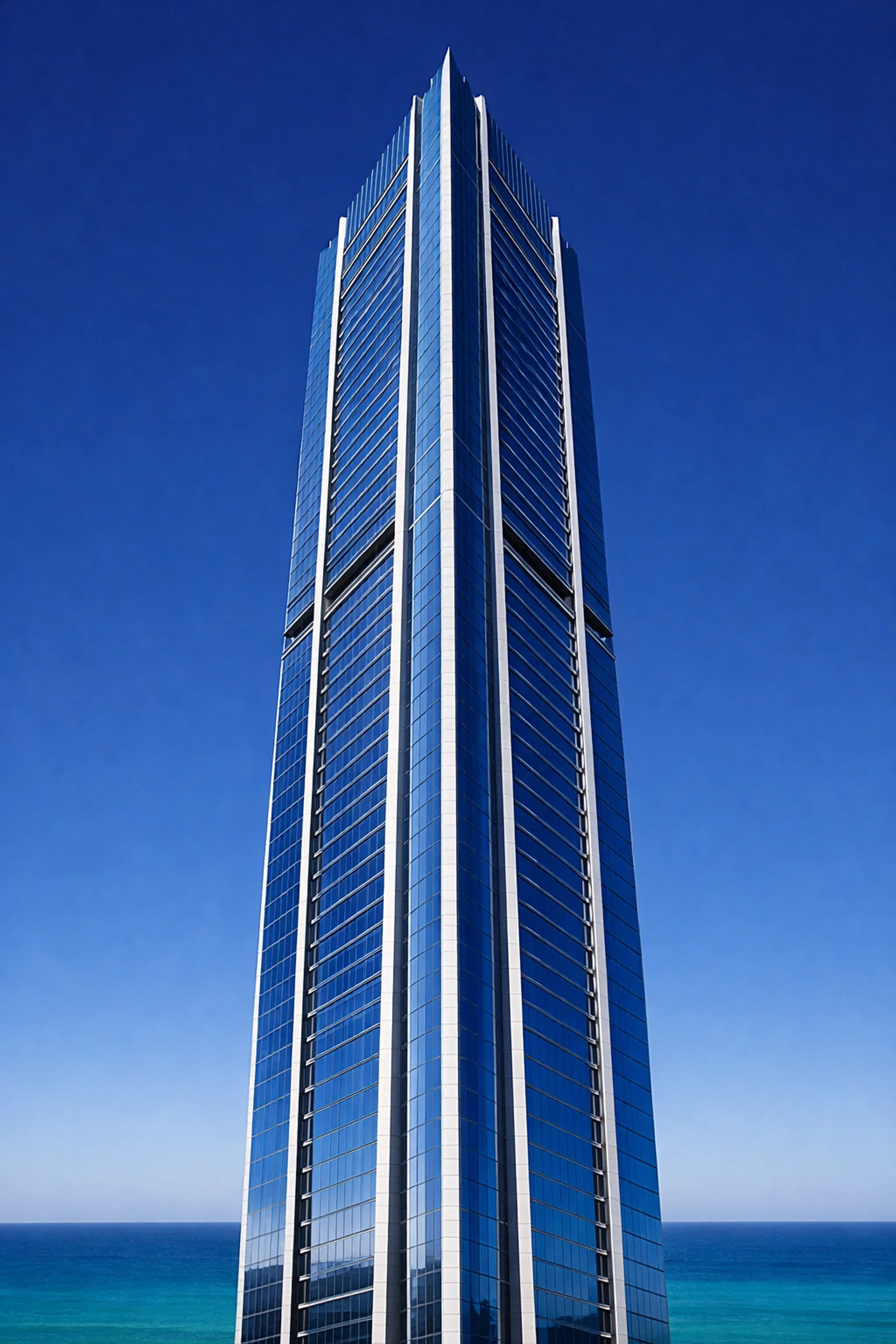
In the realm of luxury real estate and commercial architecture, the precision of the photograph is viewed as a direct reflection of the precision of the build. When a developer invests in a supertall structure, such as the Waldorf Astoria Residences: Miami’s first tower to reach the 1,049-foot threshold: the visual representation must match the engineering excellence of the project.
The technical challenges of photographing such structures are significant. Miami’s subtropical environment introduces specific atmospheric conditions, including high humidity and rapid light shifts, that require a photographer to possess both patience and technical mastery. Furthermore, the sheer scale of modern high-rises necessitates the use of specialized tilt-shift lenses to prevent vertical convergence. When a building appears to "lean back" in a photograph, it subconsciously communicates instability or a lack of attention to detail. In contrast, maintaining perfect geometric alignment reinforces the structural integrity of the design and positions the brand as one rooted in excellence.
Research Summary: The Engineering of Verticality (2026)
Recent data from Miami’s construction sector indicates that foundation pilings for supertall structures now extend 200 feet deep: more than double the depth utilized a decade ago: to address limestone subsidence and hurricane resilience (Industry Report, 2025). For the professional architectural photographer in Miami, this hidden complexity is visually translated through heavy-set perspectives and sharp, clean lines that emphasize the building’s "anchored" presence.
How Do We Capture the "Cohesive System" of Integrated Districts?
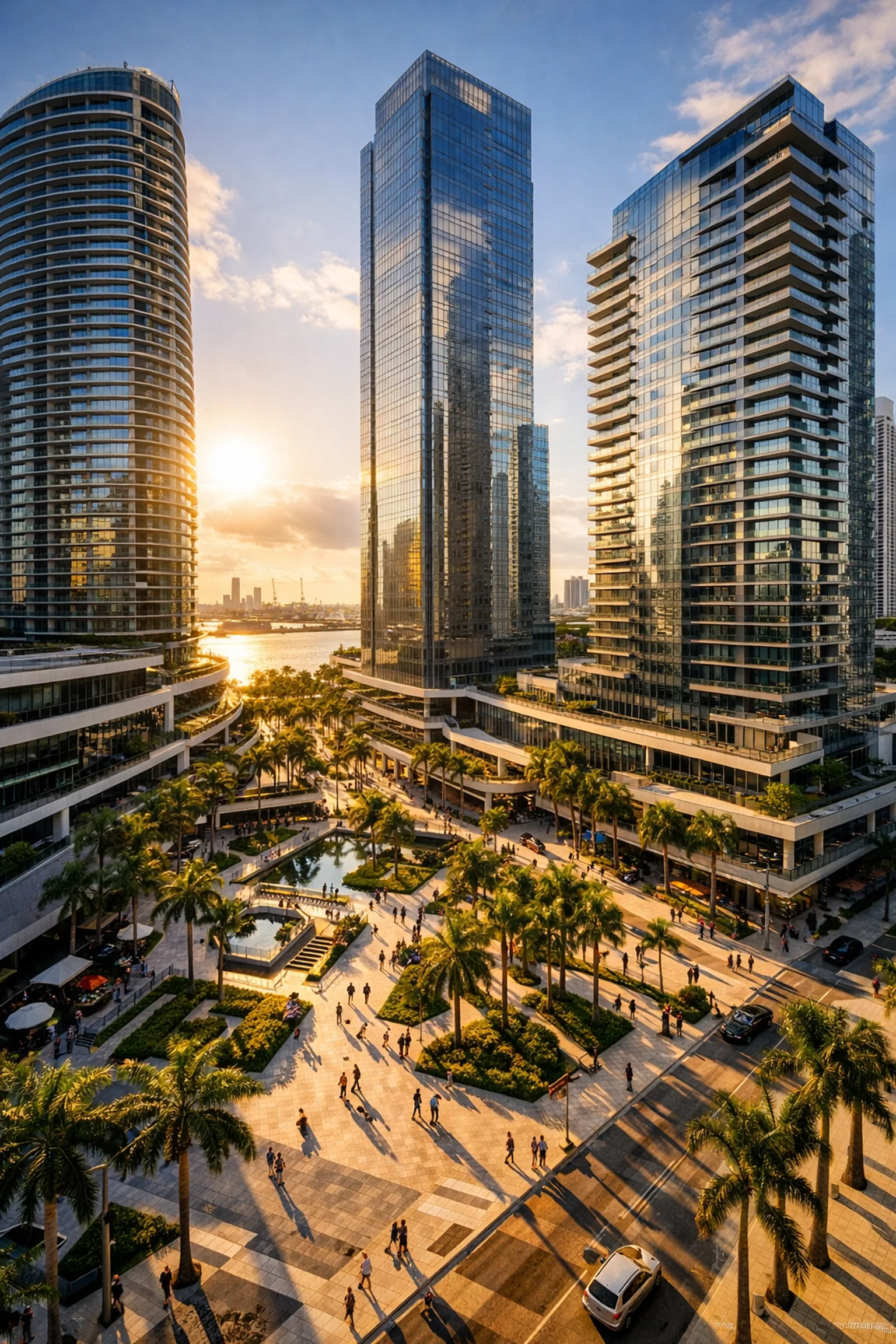
The current trend in Miami’s urban development, exemplified by the Miami World Center, focuses on integrated district planning rather than isolated towers. Design firms are now treating ten or fifteen skyscrapers as a singular, cohesive system. This shift requires a change in photographic strategy; the focus is no longer solely on the "hero shot" of a single building but on the "urban narrative" of the entire district.
To capture this, a photographer must utilize elevated perspectives and wide-angle compositions that highlight the connectivity between structures. The goal is to demonstrate how the architecture interacts with the street level, the transit systems, and the neighboring silhouettes. Indeed, luxury real estate photography in South Florida now demands a wider lens: both literally and metaphorically: to encompass the hospitality-driven amenities and resort-style spaces that define these new vertical neighborhoods.
What Role Does Geometric Alignment Play in Vertical Storytelling?
The rhythm of a building is found in its repetition: the curtain wall systems, the aluminum framing, and the glass transparency. In projects like the E11EVEN® Club Residences Beyond, the architectural language is defined by a 65-story elevation of continuous elements. Capturing this rhythm requires a disciplined approach to composition.
The Vanishing Point: Utilizing a central vanishing point can create a sense of infinite height, drawing the viewer’s eye upward and emphasizing the "beyond" aspect of high-rise living.
Materiality Contrast: High-end architectural photography must distinguish between the cool transparency of glass and the brutalist weight of rear concrete walls. This contrast is achieved through precise lighting and post-production color grading.
Symmetry and the Grid: While the title of this piece suggests moving "beyond the grid," the grid remains the foundational element of the composition. Every horizontal and vertical line must be perfectly squared to the frame to ensure a refined, editorial finish.
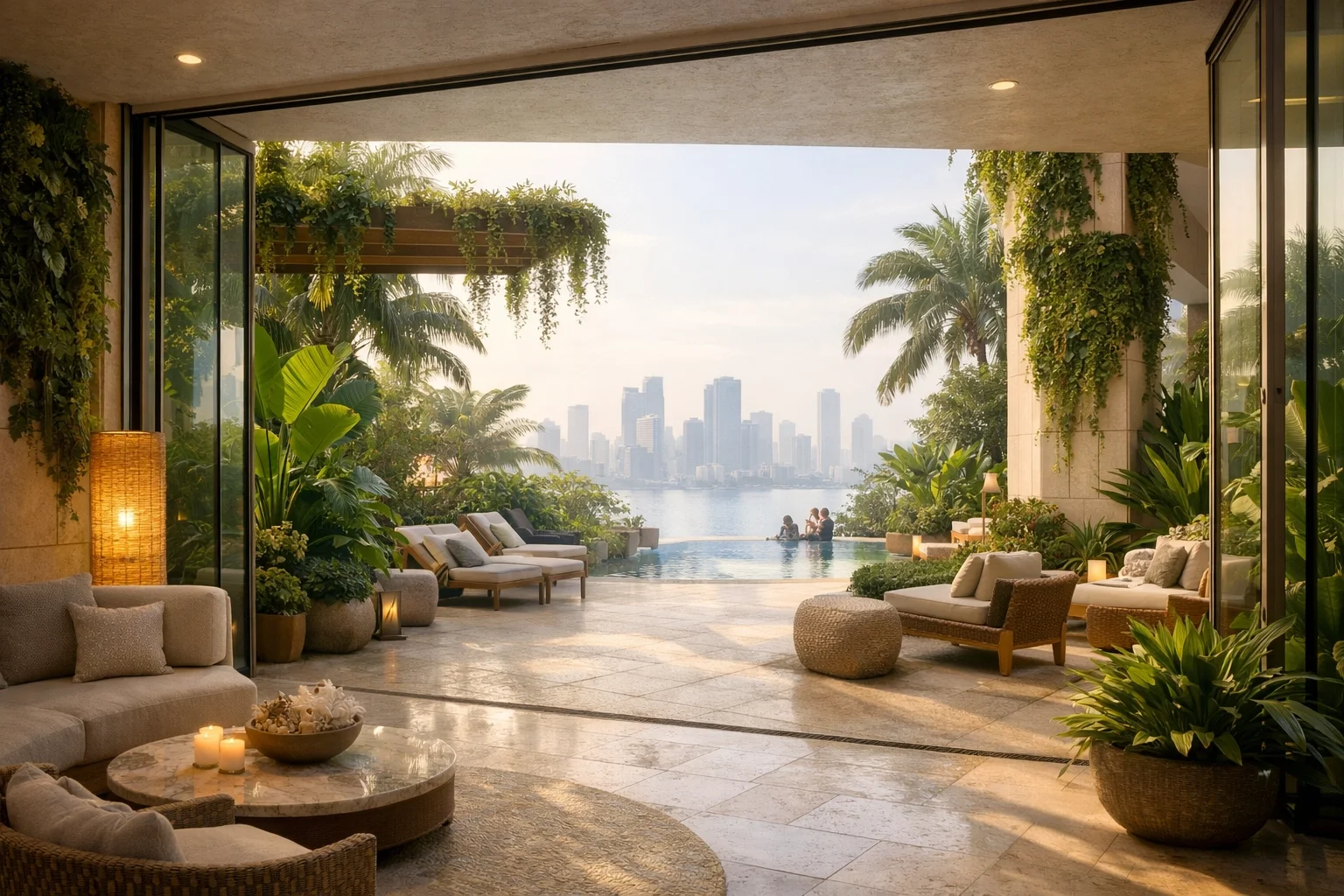
Furthermore, the use of professional interior photography within these high-rises must maintain this same geometric rigor. The transition from the exterior skyline to the interior living space should feel seamless, with the city's grid acting as a framed backdrop to the internal design.
Can High-End Visuals Mitigate the Complexity of Supertall Projects?
For developers, the construction of a supertall building is a decade-long journey fraught with technical and financial complexity. Editorial photography serves as a tool to simplify this narrative for investors and prospective buyers. By focusing on "Materiality and Light," a photographer can elevate raw materials: timber, stone, and glass: into a visual language that communicates value.
The ROI of high-quality architectural imagery is found in its longevity. A single well-composed shot of a high-rise at "blue hour" can be used for years in marketing collateral, award submissions, and brand portfolios. In contrast, lower-quality, non-technical shots often require frequent updates as they fail to capture the timeless essence of the architecture. Additionally, professional branding photographer services are increasingly integrated into architectural shoots to ensure that the human element: the lifestyle of the resident: is captured with the same level of technical precision as the building itself.
Sustainability and the Visual Communication of Innovation
As Miami moves toward more eco-conscious luxury, architecture is incorporating high-efficiency cooling systems, smart grids, and biophilic elements. Photographing these "invisible" features is a challenge that requires a strategic approach.
For instance, capturing the way natural light permeates a building can visually demonstrate the effectiveness of its sustainable design. Using a sequence of shots to show the movement of light through a space over the course of a day provides evidence of the building's harmony with its environment. This is particularly relevant when documenting Miami architecture that prioritizes climate resilience and transit-oriented development.
The Workflow: A Collaborative Partnership
At Marco Bell Photo, we view every shoot as a collaborative partnership. The process begins long before the camera is mounted on the tripod.
Pre-Production: We conduct a thorough site analysis to determine the optimal times for natural light and to identify the "power angles" of the structure.
On-Site Technicality: Utilizing high-resolution medium format systems and tilt-shift technology, we capture the raw data required for large-scale editorial prints.
Post-Production: Our editing process is refined and restrained. We focus on color accuracy, perspective correction, and the removal of distracting urban elements to ensure the architecture remains the protagonist.
Conclusion
Elevating Miami’s skyline through photography requires more than just a camera; it requires an understanding of the engineering, the urban context, and the strategic goals of the developer. By moving beyond the standard grid and embracing technical precision, we create visuals that do more than just show a building: they tell the story of a city’s evolution.
Whether you are looking to document a new high-rise project or seeking commercial photography for a retail space, the principles of geometric alignment and editorial perspective remain the same. We invite you to explore our blog for more insights into the world of professional architectural visuals.
Strategic Visual Checklist for Miami High-Rises:
Vertical Alignment: Ensure all structural lines are perfectly parallel to the frame edges.
Time of Day: Prioritize the "Golden Hour" and "Blue Hour" to capture the interplay of interior warmth and exterior sky tones.
Contextual Framing: Include enough of the surrounding skyline to show the building's place within the urban fabric.
Detail Consistency: Ensure that interior design photography maintains the same lighting temperature and perspective as the exterior shots for a cohesive brand narrative.
For firms aiming to elevate their market positioning, the investment in refined architectural photography is not merely a marketing expense: it is a foundational component of the project's identity. In the vertical race of the Miami skyline, the most precise vision always wins.